1.Traditional
Funeral Or Direct Cremation. Are There Any Options
In Between?
In the recent years, the frequency of questions we receive about cremation
has been on a steady rise. Many families want to know about the cremation
process itself as well as the options and possibilities that exist for
commemorating the life that has been lived. This handout addresses some
of the most frequently asked questions and discusses a number of available
options. It is designed to provide the information needed to make intelligent,
educated decisions.
In
the recent years, the frequency of questions we receive
about cremation has been on a steady rise. Many families
want to know about the cremation process itself as
well as the options and possibilities that exist for
commemorating the life that has been lived. This handout
addresses some of the most frequently asked questions
and discusses a number of available options. It is
designed to provide the information needed to make
intelligent, educated decisions.
2.What
Is Involved In Personalizing A Loved One’s
Ceremony?
Personalizing your loved one’s funeral ceremony is highly recommended.
We encourage families to express themselves in a manner that is a reflection
of the life that has been lived. These expressions can and should be
as unique as the individual being remembered. You can accomplish this
through tangible items such as personal photographs or through intangible
expressions such as the sharing of favorite memories.
In
addition to assisting you with creating a personal
and meaningful ceremony, this handout also presents
options for a meaningful memorialization. Many unique
options exist today to personalize memorialization.
The sundial urn is just one example. Our experienced
counselors can offer additional guidance and suggestions.
3.What
Is Cremation Anyway?
First of all, cremation is not something new and it is not a substitute
for a funeral. It’s a process that has been around for thousands
of years and is really just another method preparing the deceased for
memorialization.
The
process of cremation begins with an identification
procedure that is designed to provide peace of mind
to family members and ensure the integrity of the cremated
remains. Because cremation is an irreversible process,
positive identification of the deceased is crucial.
Once
positive identification has been established and all
necessary permits and authorizations have been obtained,
the cremation casket or container is placed into the
cremation chamber. The casket or container is then
exposed to intense heat and flame for a period of approximately
2 to 3 hours. The exact length of time necessary for
cremation will vary depending on the size and weight
of the deceased and temperatures will range between
1500 to 1800 degrees. During the cremation process
all matter will be consumed except certain bone fragments
and non-combustible items such as prostheses, casket
hinges and jewelry.
After
cremation is complete, a cooling period is required
prior to the recovery of the cremated remains. Following
the cooling period, the cremated remains are carefully
gathered from the cremation chamber and all non-combustible
items are separated and disposed of properly. The remaining
bone fragments are further processed, reducing them
to a fine, grayish-white, granular or powdery consistency
that generally weights between 4 to 8 pounds. Crematory
personnel then carefully place the cremated remains
into an urn selected by the family or into a container
designed for temporary storage.
4.Is
Anything Required Prior To Cremation?
Because of the irreversible nature of cremation, a positive identification
of the deceased is necessary prior to cremation. Any other desired viewings,
whether public or private, also must be coordinated prior to cremation.
In addition, depending on state or local laws, there may be a mandatory
waiting period before cremation can take place. In Massachusetts, for
example, cremation cannot take place within the first forty-eight hours
following death and then only after authorization by the coroner or medical
examiner of the county in which the death occurred. Additional permits
and cremation authorization forms also need to be completed by the appropriate
parties involved.
Certain
medical devices such as pacemakers and radioactive
implants must be removed prior to cremation. Pacemakers
may explode during the cremation process, which can
pose potential hazards to both crematory personnel
and equipment. Additionally, certain radioactive medications
used prior to death may also pose potential health
hazards to crematory personnel.
Any
personal items you wish to retain, such as jewelry,
should be removed prior to cremation. Any items not
removed will be destroyed during the cremation process,
or otherwise disposed of in a non-recoverable manner.
Finally,
if desired, a small number of personal items may be
placed with the deceased prior to cremation. These
items will remain with the deceased and will be consumed
during the cremation process. Specific requests are
generally not a problem, but must be identified prior
to cremation for proper coordination.
5.Are
Cremations Done Individually?
Yes. Only one cremation casket or container is cremated at a time. Special
exceptions can be made only in cases of close relatives, and then only
with appropriate prior written authorization
6.Why
Do People Select Cremation?
The reasons for choosing cremation are as varied and unique as the individuals
selecting it. Some choose cremation because of their feelings on environmental
issues and land usage; others select it to save money or because of their
religious beliefs. Cremation for some provides the option of scattering
the remains or keeping the remains at home. The reasons for considering
cremation are a highly personal reflection of an individual’s beliefs
and preferences.
7.Do
All Religions Permit Cremation?
Religious positions vary widely regarding cremation. Some require it,
others disallow or advise against it, and others take no position at
all. Most, however, will allow you to decide. If you are uncertain as
to the position your religion embraces, we would advise you to speak
directly with your clergy
8.Is
Embalming Required?
No, embalming is not required for cremation. Embalming, however, is necessary
when a cremation ceremony involves a public viewing. Some families also
elect to have embalming performed if there will be an extended delay
between the time of death and an identification viewing.
9.Everyone
In My Family Has Always Been Buried, But I Want To
Be Cremated. What Options Do I Have?
The choice between burial and cremation is a highly personal decision.
The following pages of this handout offer some options for you to consider.
These options should be used as a guide to help you create a personal
ceremony that best suits your individual and family needs. The decisions
you make truly do depend on the manner in which you choose to recognize
the life that has been lived.
Cremation
may actually present you with additional options in
funeral planning. You can decide whether to have a
public or private viewing or no viewing at all. You
can choose to have the casketed remains present for
the ceremony or to have a memorial ceremony without
the casket present. Some individuals may choose to
have a viewing followed by a ceremony at a later date
and others may wish to have a ceremony in conjunction
with the scattering of the cremated remains. The combinations
of options are limited only to your personal wishes.
10.How
Do I Personalize A Ceremony?
Families often tell us, “We want to remember him the way he was.” In
this comment is the beginning of a personalized funeral or cremation
ceremony. By remembering the qualities that made our loved one who they
were or the unique way they could make us laugh, we commemorate their
life. By sharing these memories during a service, we personalize the
ceremony. You may choose to do this through a eulogy or music, or by
creating a memory setting complete with a collage of photos and special
mementos. Creating a setting that represents an individual’s family,
work, hobbies, civic involvement or special interest can be very therapeutic
during a difficult time. Don’t discount anything as being “too
much of a bother.” Allow your imagination to guide you. Your family,
friends, clergy and cremation counselor can help.
11.Are
There Any Unique Urns Available?
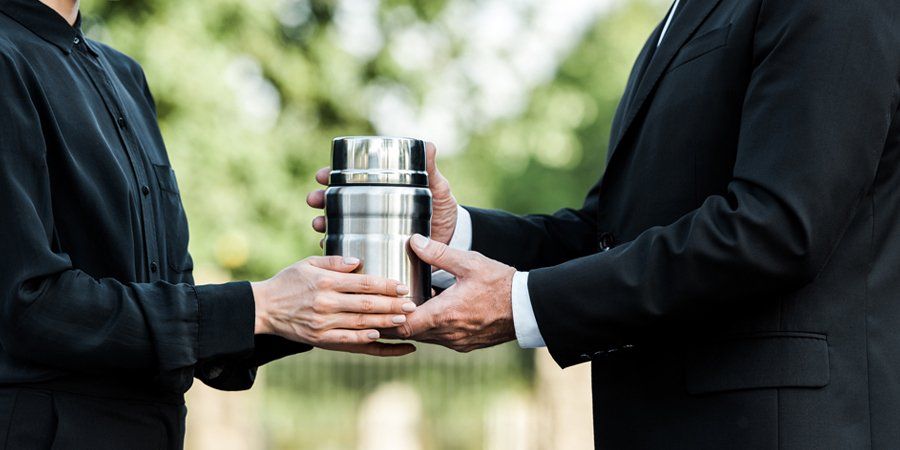
Yes. And more are being introduced every day! Some urns are designed
very traditionally while others are tailored to meet more specific needs.
Today, urns are available to meet nearly any request.
12.Is
A Casket Necessary For Cremation?
No. A casket is not required for cremation. Most crematories will,
however, require a rigid, combustible, covered container. This minimum
requirement, also referred to as an alternate container, is required
for sanitary reasons and allows for a dignified manner in which to
place
the deceased into the cremation chamber. The type of cremation casket
or container used is really a personal choice. Once selected, the
deceased is placed into the cremation casket or container for an
identification
viewing and any mandatory waiting period prior to cremation.
13.Are
There Special Caskets For Cremation?
Yes. There are caskets specifically designed for cremation. These caskets
may be used for ceremonies with public or private viewings, identification
viewings, or simply to meet the crematory’s minimum container requirement.
They are constructed using very little metal and are designed to be compatible
with cremation. We offer a wide selection of cremation caskets ranging
from solid cherry and oak to corrugated materials.
14.What
Types Of Cremation Urns Are Available?
Cremation urns are offered in a wide variety of styles and materials.
Your personal plans for the final placement of the urn can play an important
part in your selection process. Some urns are ornately designed for display
purposes while others are very basic in style. Pewter, bronze, hardwood,
ceramic, porcelain, glass and marble are just a few of the materials
used for urn construction. Many of the urns can also be personalized
with engravings or laser designs.
15.What
Do Most People Do With Cremated Remains?
Cremation is only the preparation of the deceased for memorialization
and is in many ways a preservation of our past. Through memorialization
we remember our loved ones and provide a place of pilgrimage that can
be very important to a family later in life. It is a means by which generations
are connected. What most people do with cremated remains is a matter
of personal choice. The following are some examples of your options.